
BPH treatment without general anesthesia.
Many BPH MIST procedures can be performed under sedation and local anesthesia — no intubation, no deep unconsciousness, faster recovery. Especially valuable for older and higher-risk patients.

Three anesthesia approaches in BPH treatment
Not all BPH procedures require deep sedation. From the patient's perspective, the difference between general anesthesia, spinal block, and sedation+local is dramatic — both in risk profile and recovery speed.
General anesthesia
Patient fully unconscious, breathing and circulation require mechanical support.
Used for: TURP, laser enucleation
Risk: Cardiopulmonary burden, post-op nausea, POCD in elderly
Spinal / epidural
Anesthetic injected into spinal canal — lower body loses sensation and movement.
Used for: TURP, larger-volume MIST
Risk: Headache, prolonged urinary retention, puncture site
Sedation + local
IV sedation for relaxation, local lidocaine at the prostate. Patient breathes independently.
Used for: Nexusuro, UroLift, Rezūm, iTind
Benefit: No anesthesiologist needed, fast recovery, outpatient
Which procedures can use sedation + local?
Most modern MIST procedures default to sedation + local — a fundamental shift from the TURP era. Nexusuro, UroLift, Rezūm, and iTind all share this advantage.
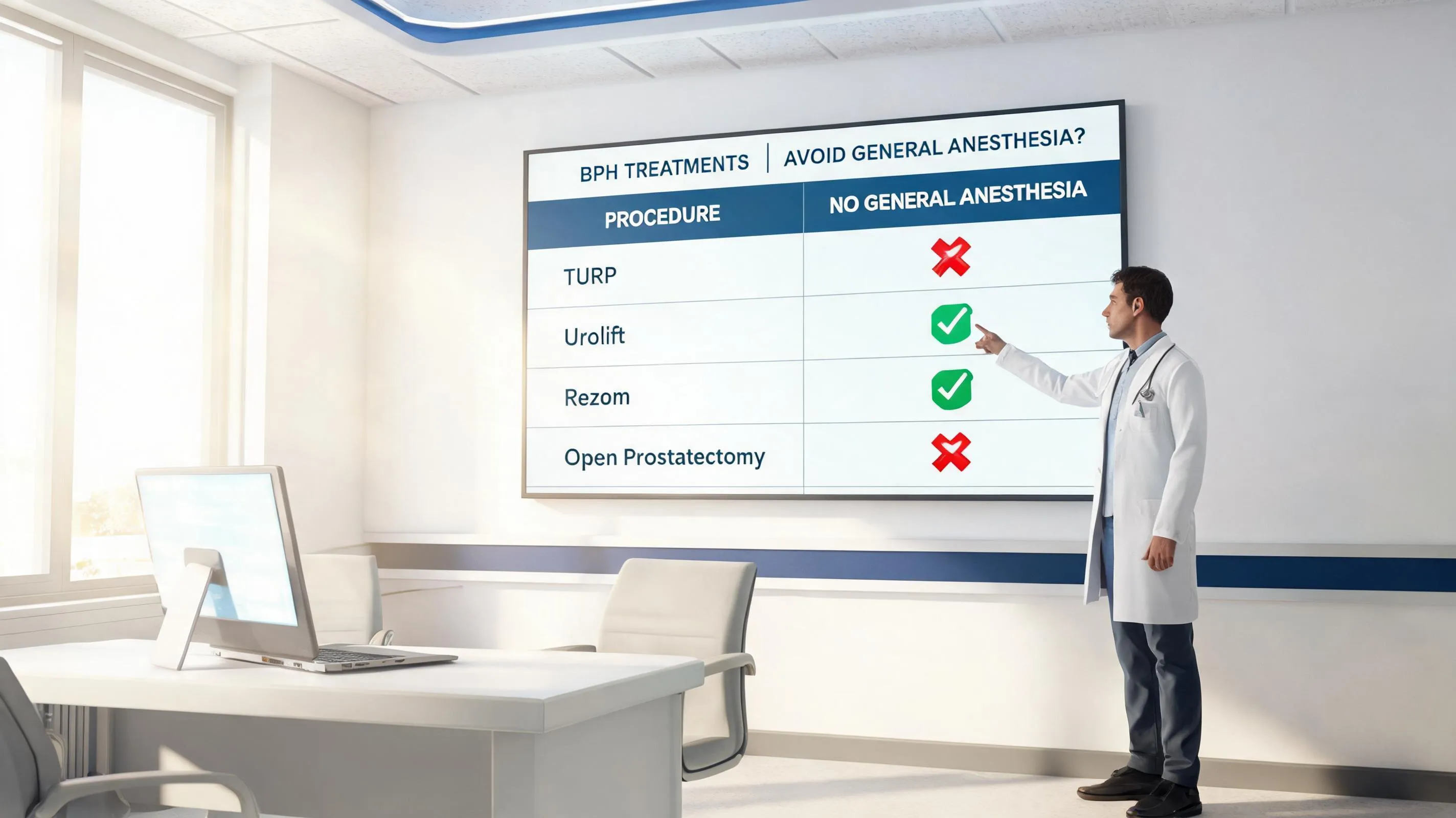
| Procedure | Standard anesthesia | Sedation + local? | Notes |
|---|---|---|---|
| Nexusuro | Sedation + local | Yes (standard) | Transurethral, no bladder neck incision |
| UroLift | Sedation + local | Yes (standard) | Classic outpatient procedure |
| Rezūm | Sedation + local | Yes (standard) | Short steam injection time |
| iTind | Sedation + local | Yes (standard) | Simple placement |
| TURP | Spinal or general | Not recommended | Requires deep anesthesia plane |
| HoLEP | General or spinal | Not recommended | Long procedure, high precision |
Special value for high-risk patients
For patients over 70 or with comorbidities (hypertension, diabetes, COPD, cardiac insufficiency), general anesthesia risk often determines whether treatment happens at all. Sedation + local removes this barrier.

| ASA Class | Definition | GA risk | Sedation+local |
|---|---|---|---|
| ASA I | Normal healthy | Low | Suitable |
| ASA II | Mild systemic disease | Low-moderate | Suitable |
| ASA III | Severe systemic disease | Moderate-high | Preferred |
| ASA IV | Life-threatening disease | High | Suitable (careful) |
Efficiency comparison
Beyond patient safety, sedation + local approaches dramatically improve hospital workflow — from shorter OR turnover to day-surgery feasibility.
| Metric | Sedation+local (MIST) | GA/Spinal (TURP etc.) |
|---|---|---|
| Pre-op prep | ~30 min | 60–90 min |
| OR time | 30–60 min | 90–150 min |
| Recovery room | ~30 min | 60–120 min |
| Anesthesiologist | Not required | Required |
| OR turnover | Fast | Slow |
| Day surgery | Ideal | Limited |
| Total stay | Outpatient → 0–1 day | Inpatient → 2–4 days |
Continue exploring
Anesthesia decisions must be made by qualified medical professionals based on individual patient assessment. This page provides general reference information only and does not constitute medical advice.