
TUCBDP professional resource center.
Clinical evidence, technical deep-dives, surgical resources, and training pathways — everything you need to evaluate TUCBDP for your practice.

CLINICAL VALUE
Why evaluate TUCBDP?
Preserves ejaculation
Does not involve the verumontanum area. Published data shows retrograde ejaculation rate 4.45%, ejaculation preserved in ~95.6% of patients.
Local anesthesia feasible
Can be performed under urethral surface anesthesia with sedation, reducing reliance on anesthesiology resources.
Low equipment threshold
No laser or RF generator required. Any hospital with endoscopic capability can adopt.
Technical principles
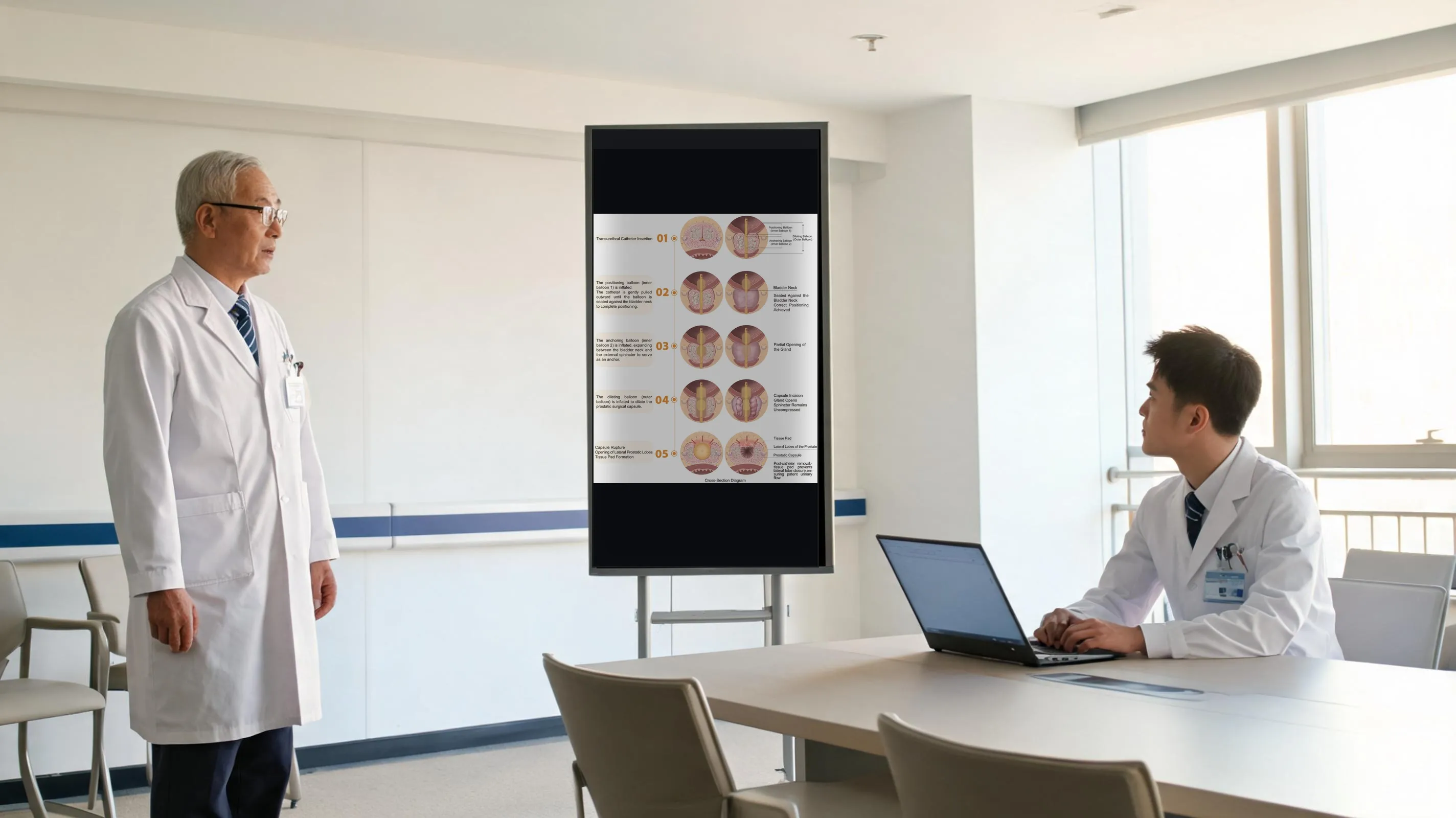
TUCBDP uses a Triple-Balloon Columnar Catheter design for uniform structural dilation of the prostatic urethra — from bladder neck to urogenital diaphragm.
Clinical data summary
| Metric | Baseline | Post-treatment | Improvement |
|---|---|---|---|
| IPSS | 20.2 ± 4.4 | 6.6 ± 1.1 | 67% ↓ |
| Qmax (mL/s) | 8.91 ± 3.13 | 18.11 | +103% |
| PVR (mL) | 76 ± 8 | 20 ± 8.5 | 74% ↓ |
| QoL score | 4.6 ± 0.2 | 1.4 ± 0.3 | 70% ↓ |
| Ejaculation preserved | — | 95.6% | RE 4.45% |
| Complication rate | — | 4.29% | vs TURP 12.86% |
Primary indications — dual focus
Small-volume prostate (≤40 mL)
A preferred MIST option. Lesions are concentrated in small prostates, making dilation more controllable. TURP risks bladder neck contracture in this population.
TUCBDP technologyPost-TURP bladder neck contracture — strong recommendation
No other commercial MIST brand has a BNC indication. Triple-balloon precision targets the contracture site without thermal energy or resection.
BNC treatment optionsProcedure comparison at a glance
| Dimension | Nexusuro | UroLift | Rezūm | HoLEP |
|---|---|---|---|---|
| Indication | Small prostate (≤40mL) + BNC; median & lateral lobe | No median lobe obstruction | <80 ml | <100 ml |
| Operation difficulty | ★★★★ | ★★★★ | ★★★★ | ★★★★ |
| Learning curve | 1-2 training sessions | Short (~10 cases) | Moderate (~20) | Long (~50) |
| Equipment | Low | Medium | Med-High | High |
Training and support
Structured curriculum
1–2 systematic training sessions covering theory, simulation, and observed procedures. 10+ standardized course modules.
Demo equipment
Complimentary demonstration devices available for hands-on practice at your institution.
Clinical support
Senior clinical specialists provide ongoing technical support throughout the adoption period.
Academic resources
This page is intended for healthcare professionals. Clinical data is sourced from published literature and internal studies. Individual treatment outcomes may vary. TUCBDP indications and contraindications must be evaluated by a licensed physician per patient circumstances.